
Photography, AI, and the Question of Intent
New Smyrna Beach, FL
Most of the photos you take today are altered by AI, whether you realize it or not.
And that isn't necessarily a bad thing. In fact, many of the images you capture, especially with smartphones, are the result of multiple shots and selective edits, all processed by machine learning algorithms to create “better” photos.
You see, photography has always involved interpretation.
For most of photography's history, choices about exposure, contrast, color, and framing were more visibly attributable to the photographer and the photographic process. The limitations were visible, and it always felt real. Today, in many cases, these decisions are made before the photographer even sees the photo, particularly when it comes to computational photography in modern smartphones.
There was a curious inflection point when this became very obvious. In 2023, some people began sharing remarkably detailed photos of the moon taken with some of the latest Samsung phones. These images showed a level of clarity far beyond what small sensors and lenses should be able to capture. In a few infamous cases, it became clear that the phone was not simply enhancing captured detail, but using learned information about the moon to reconstruct detail that the sensor itself could not clearly resolve.
The result was impressive, but also a bit strange.
This was not deception in a malicious sense. After all, the technology was giving users a result that matched their expectations of what a photo of the moon should look like, but it revealed something deeper.
The question is not whether photographs are processed; they always have been.
The question is who, or what, is shaping the image, and whether the photographer remains aware of those choices.
The problem is not tools, but authorship.
Authorship does not require making every decision by hand. It means retaining meaningful control over the process and taking responsibility for the result.
When conversations like these come up, it is common for some people to ask whether this kind of photography is still “real” photography, whatever that means.
The question is usually well-intentioned. It often comes from a desire to protect craft, effort, or authorship. However, it is also a question that quickly collapses under its own weight.
After all, photography has never been a neutral act.
What do I mean by this? Interpretation enters the frame from the moment a photographer chooses where to stand, what to include, and when to press the shutter. Even in early photography, different film stocks rendered color differently, and darkrooms allowed for dodging and burning. Today, digital sensors introduce their own biases long before machine learning enters the picture.
In reality, tools have always shaped photographs.
What really matters is whether the photographer understands their role in the process, not whether the tools themselves are involved. Confusion creeps in the moment interpretation becomes invisible, not from the fact that interpretation exists.
When authorship is unclear, so is intent.
This is why debates about whether smartphone photography is “real” enough tend to go nowhere. They focus on legitimacy rather than responsibility, completely missing the point.
A more useful question is simpler and more demanding… what is the photograph trying to do?
Intent becomes clear when we name what the photograph is for.
Once intent becomes the central question, a few useful distinctions help us understand where AI changes the nature of an image. We need to understand what kind of work is being done, not just rank one kind of photography above another.
At its most basic level, photography often lives on a spectrum between documentation and creation:
Documentation aims to record what was present. A wedding photographer is hired to preserve a moment in time, not to invent one. A street photographer captures what unfolds in real-time, not what could have been staged. In these contexts, restraint matters. The image should remain faithful to what actually occurred, even though every photograph inevitably interprets it. For example, that same wedding photographer adding people to a group photo that were not originally there, or replacing a bouquet of flowers with a random image of Moo Deng.
Creation, on the other hand, is free to imagine. Conceptual work, composites, and digitally-constructed scenes are trying to express an idea, a mood, or a vision, not document reality. Here, invention is the point of photography, not its failure.
The problem comes when these two intentions are blended without purpose.
The same distinction appears when we talk about photography versus digital art:
Photography begins with something that existed in front of the camera. Light reflected off a real scene and was recorded by a sensor or film.
Digital art may begin with a photograph, but it does not end there. It may transform, extend, or replace what was captured in service of a different goal.
Neither approach is inherently more honest than the other. They are simply doing different kinds of work.
A final distinction helps complete the picture (pun very much intended!):
Enhancement works with what is already present. Adjusting exposure, correcting color, reducing noise, or removing minor distractions does not necessarily change the category of the image. It clarifies what the photographer saw.
Fabrication introduces elements that were never there. Adding a person, replacing a sky, or inventing detail moves the image away from documentation and toward construction.
Again, this is not a moral judgment. This is a question of authorship and expectation.
When intent is clear, these tools can be used responsibly and creatively. When intent is hidden, confusion follows.
However, it is important to remember that photography does not lose its meaning when tools become powerful. It loses its meaning when we stop being honest about what we're trying to make.
AI changes the process, but not the responsibility.
Most of the time, AI enters photography very subtly, often in the name of convenience or improvement.
In many images, exposure is corrected, noise is reduced, and frames are blended automatically. These changes are often subtle enough to go unnoticed. The goal usually remains the same: to produce an image that feels closer to what the photographer actually saw.
In this sense, much of what AI does today is an extension of earlier photographic tools. It accelerates the decisions that photographers made manually by creating a more sophisticated “auto” mode. Used carefully, it can help images more closely represent what the photographer perceived in the moment.
These are the cases where AI can be truly helpful. The tension appears when AI moves from interpreting light to inventing it.
When a system starts adding detail that was never captured, replacing parts of a scene in the name of optimization, or inferring content based on probability rather than observation, the photo changes category. It becomes less a record of what was seen and more a construction of what the system believes should have been in the scene.
The result is not meaningless or invalid, but it is very much different.
At that point, the photographer is not simply choosing where to stand or press the shutter. They are forced to choose how much authorship to delegate, and whether they understand what is being delegated in the first place.
If the goal is to document, the use of AI requires restraint. If the goal is to create, it requires honesty. Either way, the responsibility to be clear about what kind of image is being made still belongs to the person who shares it.
Tools may change, but responsibility remains.
Creative agency depends on how much choice we retain.
The way we stay grounded when faced with these changes is by remaining attentive to where choice still exists.
In many modern photography workflows, particularly on smartphones, decisions are made automatically and invisibly. In many cases, this can be liberating. However, it can also be disorienting.
For photographers who care about retaining a sense of authorship beyond simply capturing a moment quickly, having access to choice matters, because authorship is ultimately more than technical control.
“In producing a work, artists express themselves to the point where their work becomes a unique disclosure of their own being, of what they are and of how they are what they are.”
— Pope St. John Paul II, Letter to Artists
This is not a rejection of computational photography… far from it. What matters is simply being aware when it's helping, and when it's making decisions on your behalf.
There are some tools out there that make it easier to see this boundary. On the iPhone, for example, there are apps that intentionally reduce or bypass computational processing, allowing the photographer to decide how much interpretation is applied after the fact. Halide's Process Zero is one of these options. It exists as an invitation to remain involved in the image-making process, not merely as a rejection of technology.
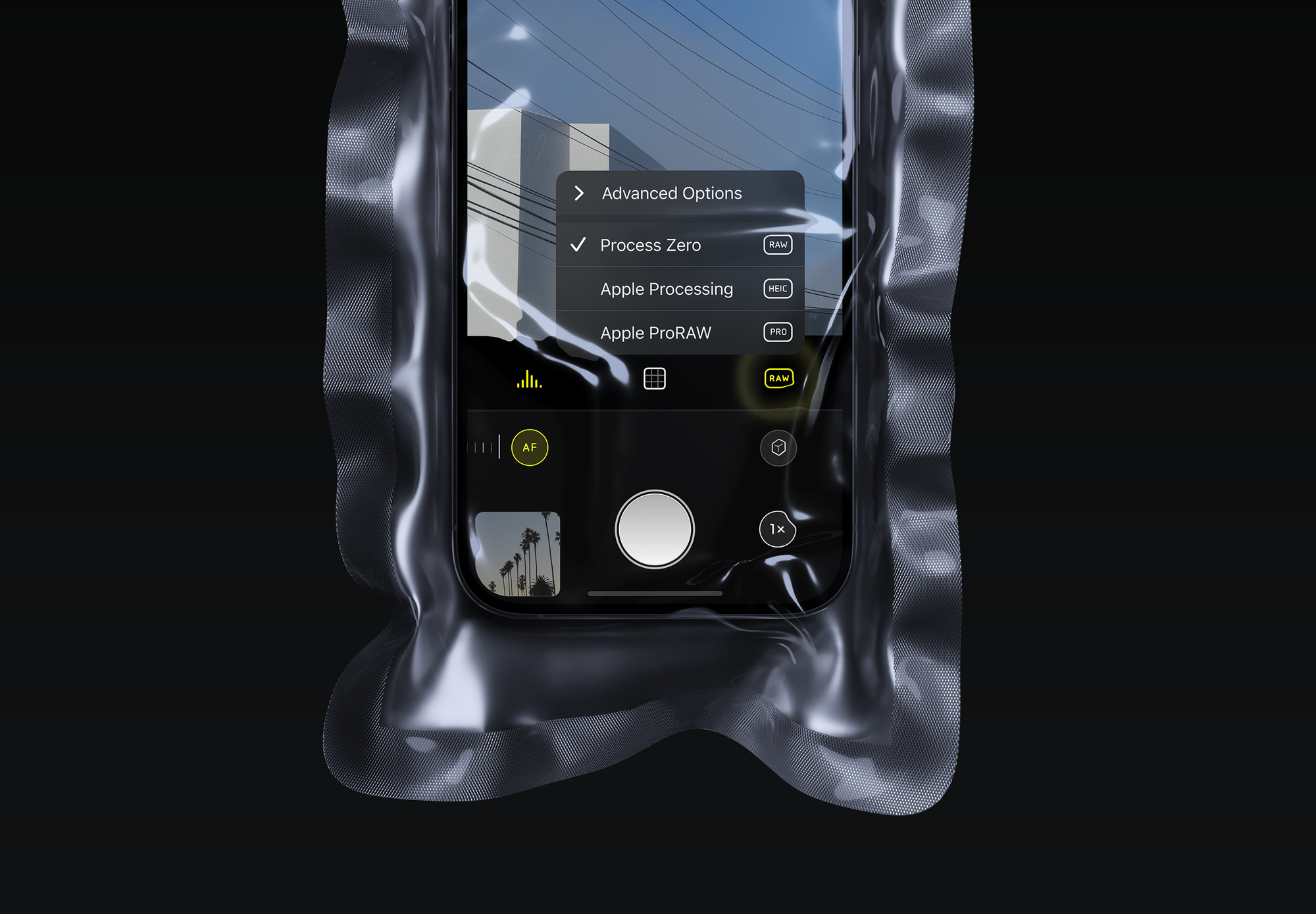
Process Zero in Halide. Image: Lux Optics
The point is awareness.
Choosing restraint is still a choice. So is choosing automation. We just need to be intentional when we choose.
The same principle, though to a lesser degree, applies to dedicated cameras. Shooting RAW preserves more of the decisions for the photographer, rather than allowing the camera to finalize them automatically.
Creative agency is about staying present enough to know when you are deciding, and when something else is deciding for you.
In the end, photography is still an act of intention.
AI will continue to evolve, and the line between assistance and creation will continue to blur.
None of this changes what photography ultimately asks of the person holding the camera. Every photograph still begins with a decision (where to stand, when to press the shutter, what to accept, etc.). AI may accelerate these decisions, or even obscure them, but it does not remove them.
This is why intent matters more now, not less.
AI should serve your creative purpose, not define it.
